
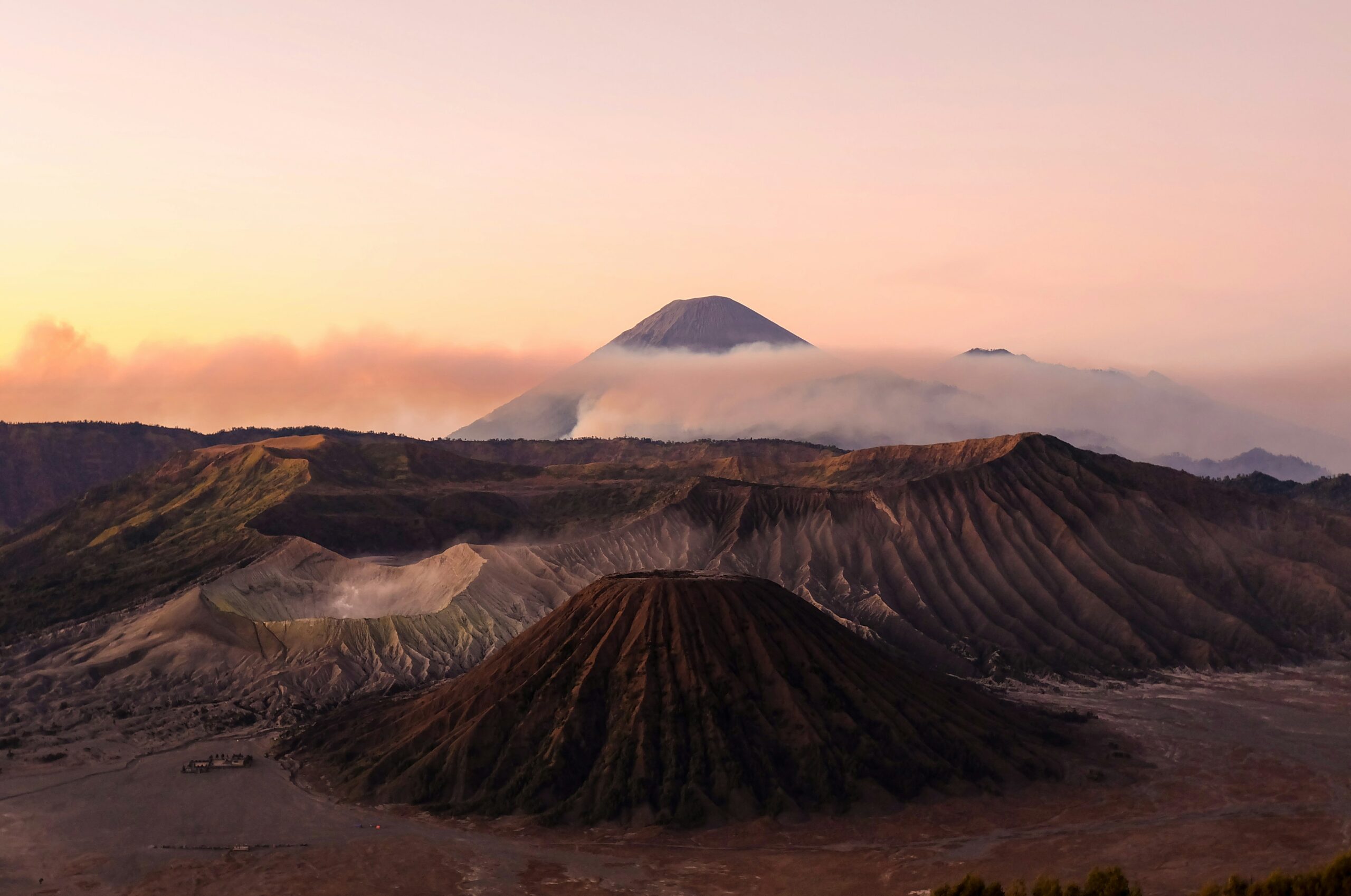
Everything you need to plan an independent trip to Indonesia
Indonesia is an archipelago of more than 17,000 islands stretching between Asia and Oceania. Active volcanoes, tropical forests, rice terraces, incredible marine life and cultures that change completely from one island to the next make it almost impossible to think of Indonesia as a single destination.
Over the past few years, we have spent around four and a half months backpacking around the country, returning several times and visiting very different islands. This guide brings together what we have learned about planning an independent trip to Indonesia, from practical information to itineraries across the islands.
When to visit Indonesia
Indonesia has a tropical climate and is warm and humid throughout the year. Across much of the country, including Java, Bali and the Nusa Tenggara islands, the dry season generally runs from April to October, while the rainy season falls mainly between November and March. Conditions can vary considerably between regions, though, so check the best time for the particular islands you plan to visit.
July and August are peak tourist season, especially in popular destinations such as Bali. That does not mean you have to avoid them: move away from the busiest areas and you can find a very different atmosphere.
In general, April to June and September to October are great months for many of the classic destinations. You miss the biggest crowds of July and August while staying mostly within the dry season.
Entry requirements for Indonesia
To enter Indonesia, your passport must have at least six months of validity remaining. Italian citizens can obtain a Visa on Arrival (B1), valid for 30 days from entry. It can be extended once for another 30 days, for a maximum stay of 60 days.
You can obtain the visa on arrival or apply online before departure, which we recommend if you want to avoid potential airport queues. Use the official Indonesian immigration portal: Indonesia e-VOA – official website. The B1 costs IDR 500,000. You may also be asked to show a return or onward ticket when entering the country.
If you want to stay longer than 30 days, you can extend the visa once for another 30 days by paying an additional IDR 500,000. You can start the application on the same website, but note that since 29 May 2025 the extension has no longer been entirely online. After submitting the application and paying, you need to visit the designated immigration office in person for a photo and a short interview. The office is determined by the address you enter in your application, so make sure your accommodation address and postcode are correct.
Tip: if you are travelling without a fixed departure date, onward ticket services can provide a real temporary flight reservation with a verifiable PNR for a small fee. It is not a ticket you can use to fly: the reservation remains valid for a limited time before being cancelled. Alternatively, buy a flexible ticket.
Bali tourist levy
If your trip includes Bali, remember that international tourists must pay a tourist levy of IDR 150,000 per person. You can pay online before arrival through the official Love Bali website.
You pay the levy only once during the same trip to Indonesia. For example, if you arrive in Bali, travel to Lombok and then return to Bali without leaving Indonesia, you do not have to pay it again.
For current entry requirements and safety information, we recommend checking the Indonesia page on the Italian Ministry of Foreign Affairs website, Viaggiare Sicuri (in Italian), as well as the official Indonesian immigration portal.
Getting around Indonesia
Getting around Indonesia might look complicated when you consider the country’s size and its thousands of islands, but travel is generally fairly straightforward, especially along popular routes. Depending on the island and distance, you can combine domestic flights, ferries, buses, trains and private transfers.
Here are the main options for travelling around the country.
Scooter
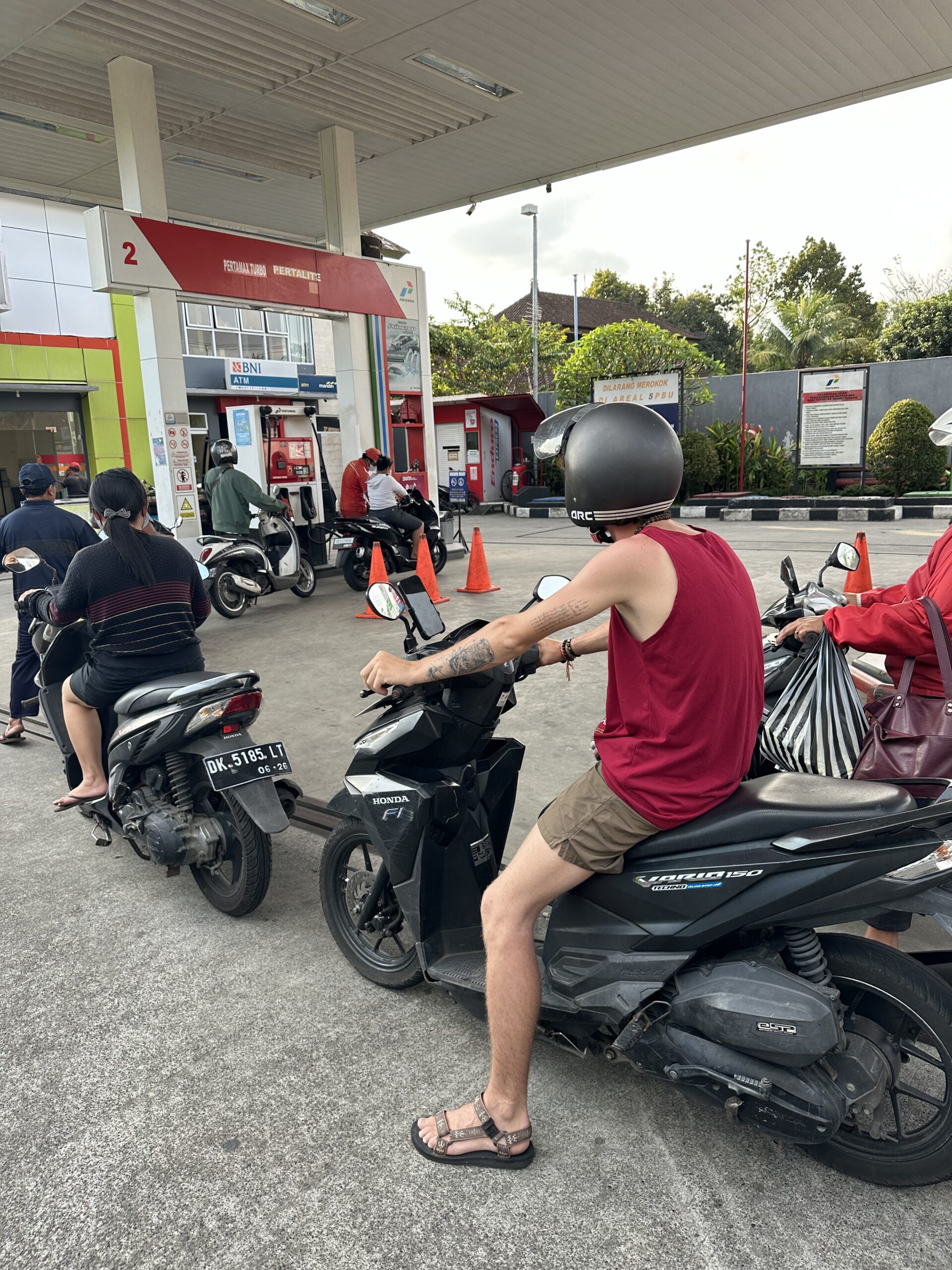
One of the most convenient and affordable ways to explore Indonesia’s islands is to rent a scooter. It gives you the freedom to reach places where public transport is virtually nonexistent.
Traffic can be quite chaotic, particularly in cities and busy areas, and road conditions vary enormously from one island to another.
In Bali and other tourist destinations, scooter rental and fuel are generally cheap: we paid about €4.50 per day. On islands with fewer rental options, prices may be a little higher. In Flores, for example, we paid around €6 per day. It is not a huge difference, but a few euros add up when you travel on a budget. A longer rental does not always mean a lower daily rate, so ask for the price for your entire rental period.
To ride legally in Indonesia, you need your Italian driving licence together with an International Driving Permit under the Geneva Convention, including the appropriate motorcycle entitlement if you intend to ride a scooter. Helmets are mandatory for both rider and passenger. Before renting, check the terms of your travel insurance: riding without a licence valid for that vehicle could affect your cover in the event of an accident.
One service we heard about while travelling in Flores is Motor Adventure Bali. You can pick up a motorcycle in one place and drop it off in another, allowing you to cross several islands without returning to your starting point. One of its routes runs from Jakarta to Maumere via Java, Bali, Lombok, Sumbawa and Flores. We have not tried it ourselves, and it is not a cheap option, but it may appeal to anyone who wants to cross part of Indonesia on two wheels.
Buses and trains
Indonesia has a good network of long-distance buses, particularly on larger, more populated islands such as Sumatra and Java. Many cities have a main terminal served by several companies, although journey times and comfort levels vary considerably by route and type of bus.
You can buy tickets at bus terminals or book online through platforms such as RedBus and Traveloka. Private minibuses and shuttles also run on some routes. They are generally faster and more comfortable, but cost more.
Java has a well-developed railway network connecting major cities including Jakarta, Bandung, Yogyakarta and Surabaya. Trains are affordable, comfortable and generally punctual, making them one of the best ways to travel around the island. You also get some lovely views along the way.
You can buy tickets through the official KAI – Kereta Api Indonesia website or through platforms such as Traveloka. For popular routes, book a little in advance.
Flights
Indonesia is an enormous archipelago, so flying is often the fastest and most practical way to travel between islands. Airlines such as Garuda Indonesia, Lion Air and AirAsia connect many of the country’s main cities and tourist destinations. Domestic flights are generally reasonably priced, especially if you book in advance. Reaching more remote islands may require one or more connections, often via Jakarta, Surabaya, Denpasar or Makassar.
We have flown with several airlines in Indonesia and, when it is available, AirAsia is still the one we have had the best experience with.
Ferries and fast boats
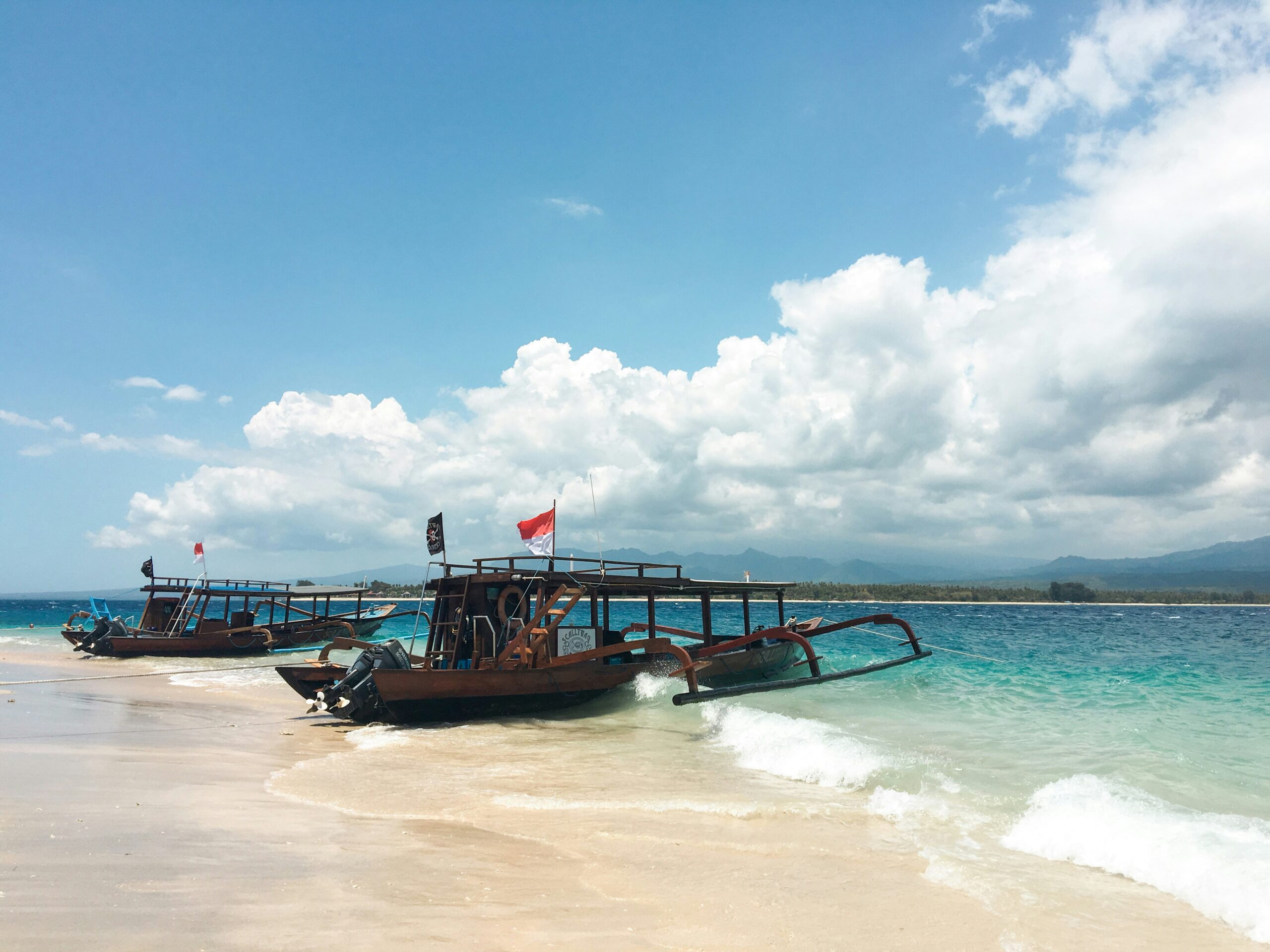
Ferries are essential for island hopping and connect many destinations, including Java, Bali, Lombok and the Gili Islands. Conventional ferries are generally cheap but slower, while fast boats cut travel times considerably.
In light of recent accidents, we recommend looking beyond the cheapest fare and, where possible, paying a little more for an established operator. Between Bali, Lombok and the Gilis, we would consider Eka Jaya Fast Ferry and Wahana Virendra Fast Boat. We travelled with Wahana Virendra and had a good experience.
We almost always bought our tickets through local agencies or directly from our guesthouses, which often included a transfer to the port. In high season, book a few days ahead.
Grab and Gojek
Ride-hailing apps such as Grab and Gojek are widely used in Indonesia, particularly in cities and tourist areas. Rides are generally affordable, and the price, route and driver are shown in the app, so you do not have to negotiate with taxi drivers.
Both apps also let you book an ojek, or local motorcycle taxi. It is a particularly cheap and quick option for short journeys, especially in heavy traffic.
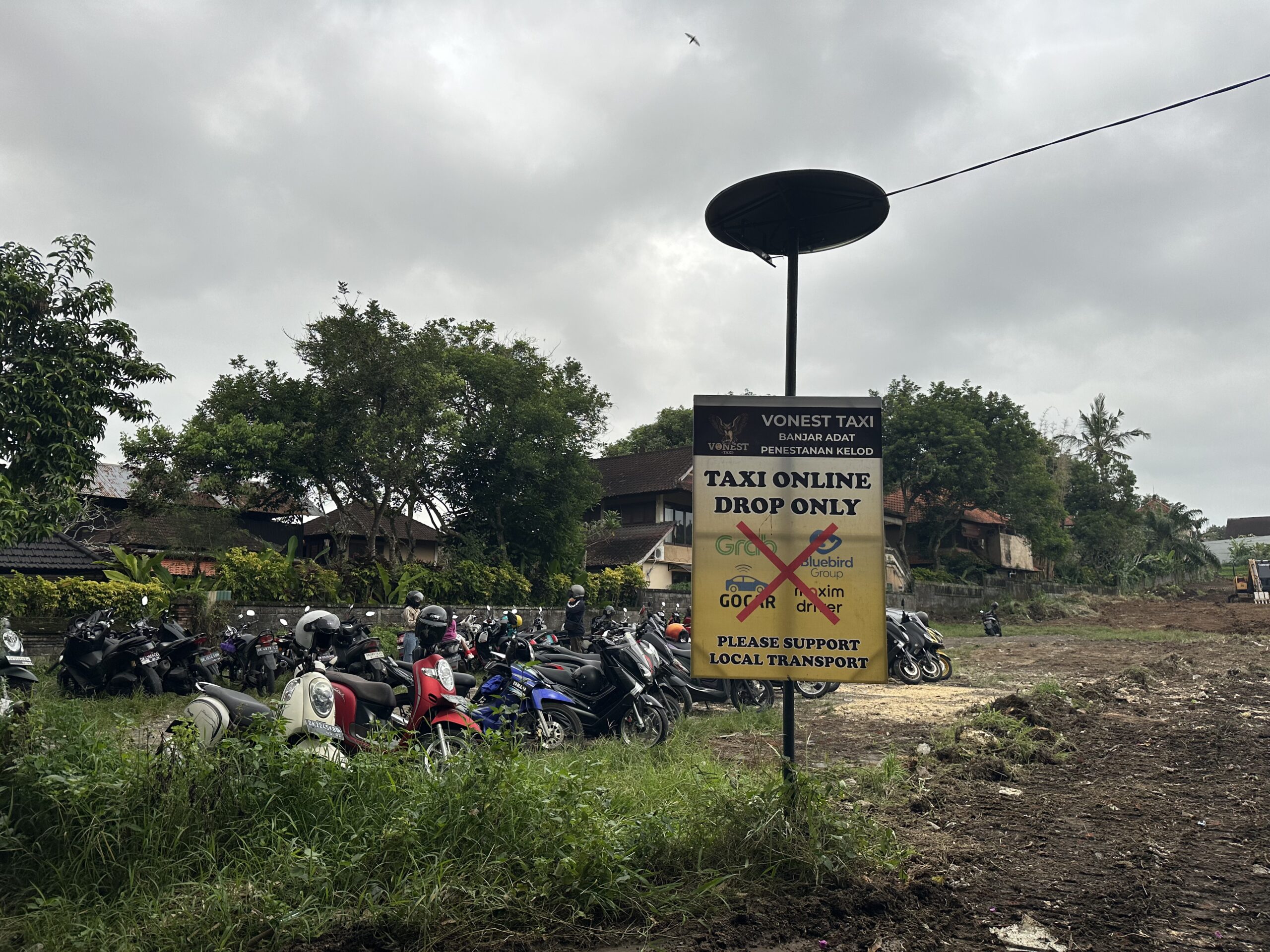
Outside major centres, service may be limited or unavailable. Some areas also restrict app-based passenger pickups. We came across this in Kintamani and parts of Ubud outside the centre, where signs indicate places where Grab and Gojek cannot pick up passengers.
Private driver
Hiring a private driver is common in Indonesia, especially if you want to see several places in one day without worrying about transport. The easiest option is to ask your guesthouse or a local agency. In Bali, for example, you will find drivers offering day trips almost everywhere.
Another option we have used several times is to book a driver through Grab or Gojek and ask whether they are available for the whole day at an agreed fixed price. You can do the same if you simply need someone to wait while you visit a place. It has always worked well for us: agree on the price, duration and itinerary before setting off to avoid misunderstandings.
Money and internet access
Cash is still widely used in Indonesia, especially at warungs, small shops, guesthouses and in less touristy areas. Hotels, restaurants and supermarkets generally accept cards. In recent years, QRIS, the local QR-code payment system, has also become extremely widespread.
To keep withdrawal costs down, we recommend using a travel-friendly bank card (our guide is in Italian) and withdrawing from ATMs at banks rather than from isolated or questionable machines. We often use Mandiri, BNI, BRI or Maybank ATMs.
For mobile internet, we have almost always used Telkomsel, which has extensive coverage even beyond the main tourist areas. You can buy a SIM at official stores and authorised retailers, and they are easy to find in popular destinations.
We bought two SIM cards at Bali airport and paid about €29 in total for one month. Prices vary a lot depending on the data allowance and where you buy them, so take that figure simply as an example from our experience.
eSIMs have become very common, but international plans often cost more than a local SIM, and coverage depends on the Indonesian network they use. For most travellers, we think a local SIM or an eSIM from an Indonesian operator is the better choice, particularly if you plan to visit less touristy areas.
What to see in Indonesia
Indonesia is an enormous archipelago, so we have written a separate article for each island or group of islands we have visited. Below are our guides, with itineraries, places to see and practical advice for planning your trip. The detailed island guides are currently in Italian.
How much does a trip to Indonesia cost?
Indonesia remains a fairly affordable destination, particularly if you eat at warungs and stay in locally run accommodation. We spend around €2–3 per person for a meal, while a private room with a bathroom has often cost us about €5–10 per person per night.
Of course, your budget will vary widely depending on the islands you visit and what you do. Diving, organised hikes and multi-day tours can quickly increase the cost.
On our first trip, lasting about six weeks, we spent an average of €26 per person per day, including accommodation, food, transport, domestic flights and attractions.
Safety in Indonesia
Indonesia is generally a safe destination for travellers. The most common problems are petty theft and bag snatching, especially in crowded tourist areas. Be particularly careful with your phone when riding a scooter: avoid holding it or leaving it in an easily reachable mount, as thieves can grab it as they pass.
One of the main risks is traffic, which can be heavy and chaotic, especially in Bali. Road conditions vary from place to place, and driving habits may be very different from what you are used to.
In tourist areas you may also encounter minor scams, inflated prices or unofficial guides. We have had people ride alongside us on a motorbike and insist on showing us around the attractions. In such situations, a firm refusal and continuing on your way is usually enough.
Indonesia has extremely strict drug laws. Even possession can lead to severe penalties, and some drug-related offences carry the death penalty.
Hygiene and food safety
Before our first trip, we heard countless stories about the notorious “Bali belly” and stomach problems in Indonesia in general. The reality is that getting sick is far from inevitable.
We eat almost exclusively at warungs and small local restaurants, have drinks with ice and do not worry excessively. Of course, tap water is not considered safe to drink, so we use filtered or bottled water. Otherwise, we take the same ordinary precautions we would on any trip.
Standards of cleanliness vary between places, and accommodation in remote areas can be basic. That does not necessarily mean poor hygiene. In fact, some of our best meals have been in the simplest places.
Indonesia itineraries
Indonesia has more than 17,000 islands, and seeing them all would take years. To help you plan, we have put together a few classic routes that you can combine into a trip lasting several months. There is no perfect itinerary for everyone: use these ideas as a starting point and adapt them to your interests, budget and the season when you travel.
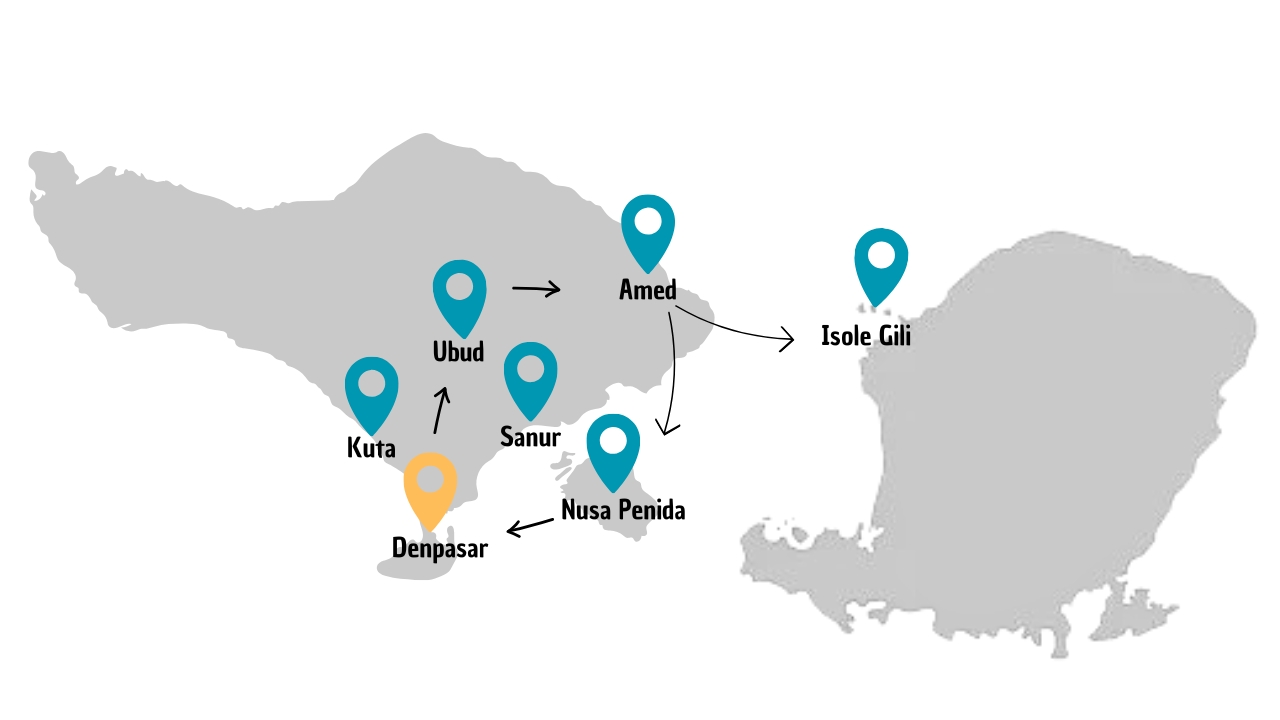
15-day itinerary: Bali and Nusa Penida or the Gili Islands
We think this is an excellent itinerary for a first trip to Indonesia. With just 15 days, we would leave Lombok for another time: otherwise, you would barely see it and end up rushing. Of course, you can include it if that is what you prefer.
South Bali
Days 1–4 (3 nights): choose a base from the towns in our Bali guide. We recommend Sanur.
Arrive, transfer to your hotel and relax. On day 2, enjoy the beach in the morning and perhaps visit Tanah Lot Temple around sunset, or simply spend the whole day by the sea. On day 3, explore the Bukit Peninsula and Uluwatu Temple.
Ubud and the surrounding area
Days 4–8 (4 nights).
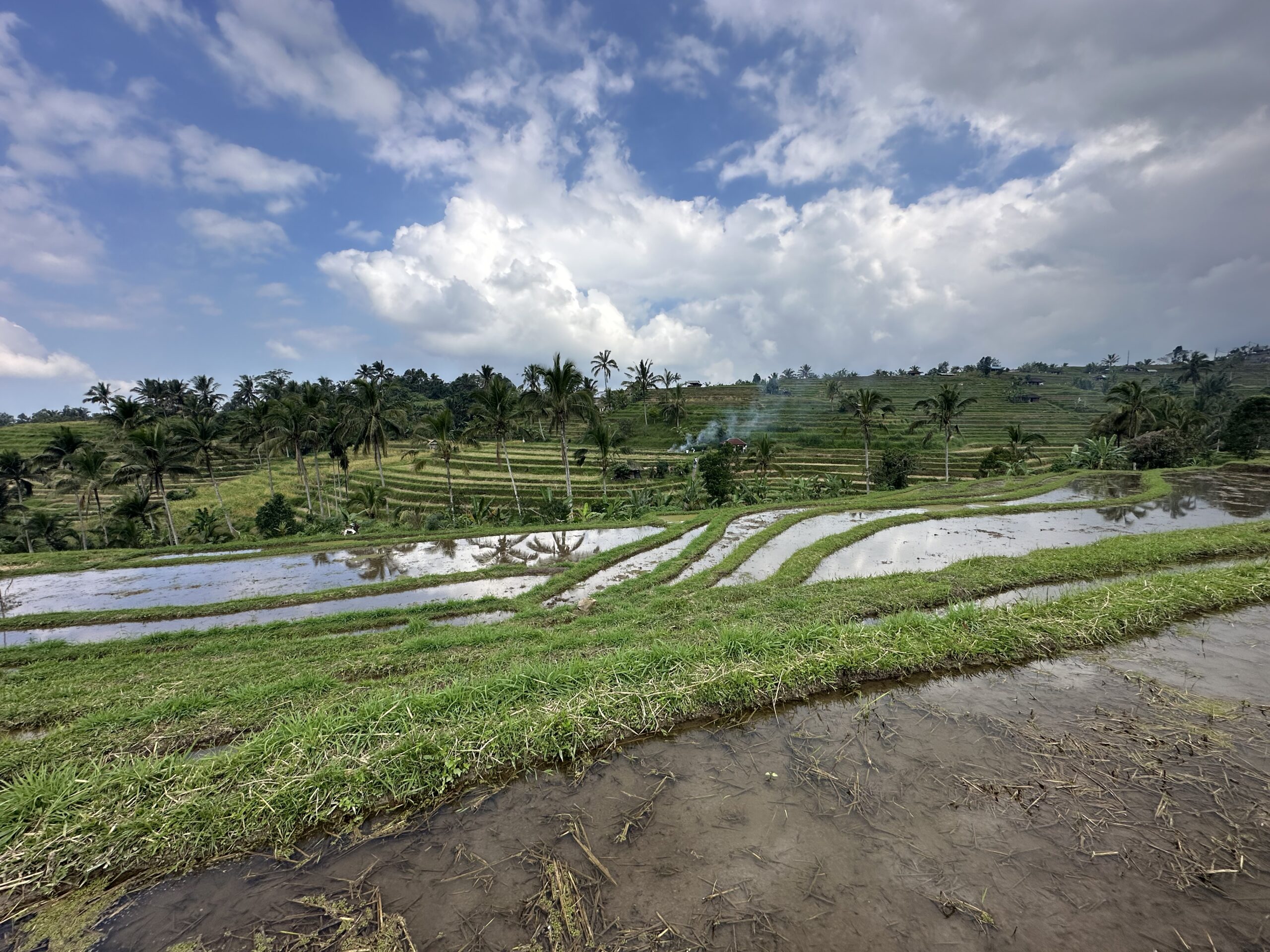
Travel to Ubud on the morning of day 4 and use the town as a base for exploring central Bali. Visit the central market, Ubud Palace or the Monkey Forest. Over the next three days (days 5–7), see the rice terraces at Tegallalang and Jatiluwih, taste tea and coffee at a coffee plantation, and visit temples and a few waterfalls. We would not particularly recommend Mount Batur, but if climbing it appeals to you, go for it.
East Bali
Days 8–10 (2 nights): we recommend staying in Amed.
Head east on day 8 and enjoy the beaches. Make time for the beautiful Mother Temple, Pura Besakih.
Nusa Penida or the Gili Islands
Days 10–14 (4 nights).
Travel to the islands on day 10. Spend your remaining days by the sea and take it easy.
South Bali
Return to southern Bali, near the airport, on day 14 and fly home on day 15.
Three-week itinerary: Bali and Lombok or Flores
With three weeks, you can consider continuing to Lombok or Flores. Both islands have a lot to offer, so they are well worth adding when you have more time.
For Bali, you can follow the itinerary above and perhaps add another three or four days around Lovina in the north and Munduk in the centre. Here are a few options for the rest of your trip.
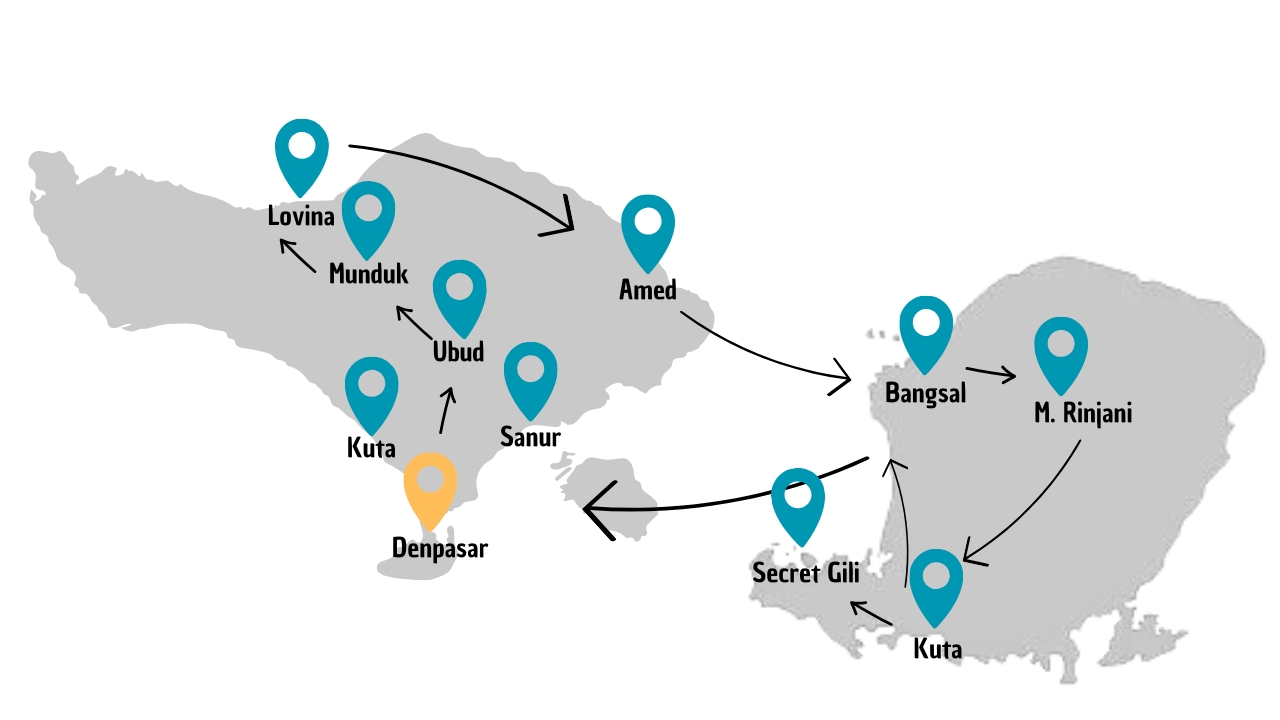
Option 1: Lombok
There are essentially two ways to get from Bali to Lombok: take a ferry from Padangbai or fly to southern Lombok in about 45 minutes. Depending on your interests, you can hike Mount Rinjani or focus on the beaches.
Alternative 1: Mount Rinjani trek and Kuta Lombok or Tetebatu
For this option, we suggest taking a few days away from Bali.
Days 1–3 (2 nights).
Arrive in Lombok from Bali and transfer from Bangsal port to Senaru. On day 2, arrange your trek and visit nearby waterfalls.
Days 3–6 (3 nights).
Spend days 3–5 trekking, returning to your base at the end of the trek.
Days 6–8 (2 nights).
On day 6, head south to Kuta. Spend day 7 on the beaches or visiting the Secret Gilis. Alternatively, explore the Tetebatu area. Return to Bali on day 8; if time is tight, consider flying.
Alternative 2: beaches
If you want a more relaxed trip, spend the week exploring Lombok’s beaches. This option also leaves room for those extra three or four days in Bali. You will find all our tips in our Lombok and Gili Islands guide (in Italian); consider including the Secret Gilis as well.
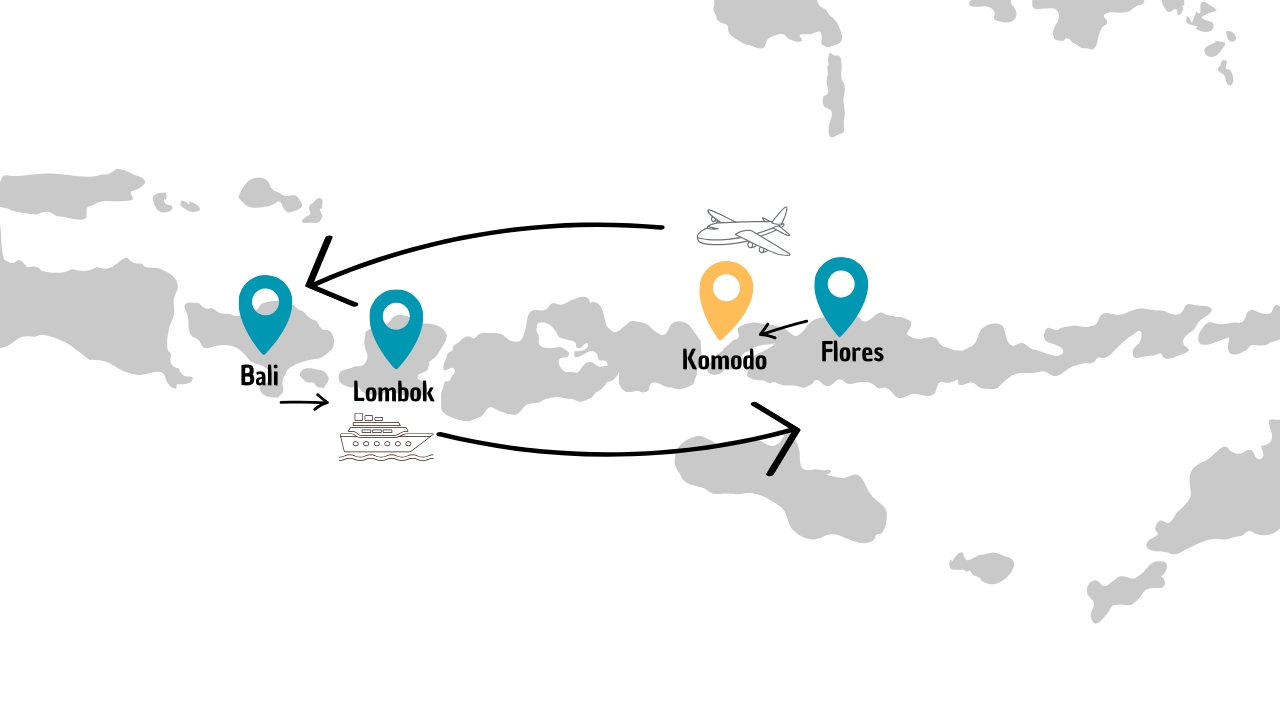
Option 2: Flores
Flores is the island we enjoyed most. It is still somewhat removed from mass tourism, though that is changing. There are two main ways to get there: a four-day, three-night boat trip from Lombok or a flight to Labuan Bajo. Choose the option that suits your plans.
Alternative 1: boat trip
Days 1–4 (3 nights).
You will spend four days on a boat, passing several Indonesian islands and stopping in Komodo National Park before reaching Labuan Bajo. Many travellers who arrive in Flores by boat fly back to Bali the next day. If you have more time, you could rent a scooter and explore the surrounding area. We suggest a few places in our Flores guide (in Italian).
Days 4–5 (1 night).
Arrive in Labuan Bajo on day 4 and explore the town. Fly back to Bali on day 5.
Alternative 2: flight
Days 1–5 (4 nights).
Five calendar days give you around three full days on the ground. You could take a day trip to Komodo National Park, spend another day on a snorkelling tour, then rent a scooter to visit Rangko Cave or a few waterfalls.
This is only a starting point. Add or remove stops according to the time you have and your arrival and departure airports.
Final thoughts
If you have made it this far, thank you for reading our guide to planning an independent trip to Indonesia. We hope it helps you put together your itinerary. Indonesia is one of our favourite countries in Southeast Asia. We have returned several times and spent months travelling here. The food, the people, the landscapes, the volcanoes, the islands and the incredible sea are just some of the reasons we keep coming back.
If you have any questions, leave us a comment. We are always happy to help if we can. Terima kasih!