
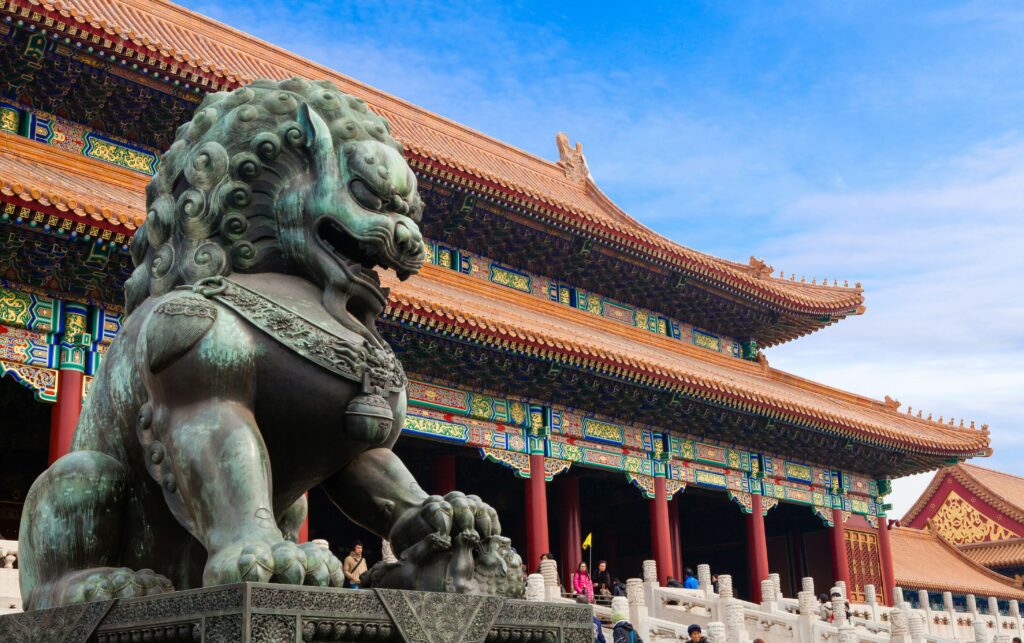
China is one of those countries that, at least at first, can seem complicated to organise independently. It is enormous, many of the apps we use every day do not work, payments work very differently from what we are used to, and several attractions need to be booked in advance. Yet once you understand how things work, travelling independently in China is much easier than it may seem.
Italian citizens can also currently travel to China visa-free for stays of up to 30 days, thanks to the exemption currently valid until 31 December 2026.
We received a huge number of questions about our trip, so we decided to collect them in this guide and answer the most common ones. A couple of weeks is obviously not enough to see one of the largest countries in the world, but it is enough to understand how to get around, how to book the main attractions, how to use the internet despite China’s online restrictions, and everything else you need to plan an independent trip to China.
When to visit China
China is a huge country and the climate varies considerably from one region to another. In general, the best times to travel to China are spring, especially April and May, and autumn, between September and October, when temperatures are milder.
Summer can be very hot and humid, especially in central and southern regions, where rainfall also increases. Winters are particularly cold in the north, especially around Beijing. In southern China the climate is generally milder, although rain and typhoons can affect travel at certain times of year.
Also keep Chinese national holidays in mind. Millions of people travel around the country during these periods, and transport and attractions can become much more crowded. In particular, if possible, avoid Golden Week at the beginning of October.
We travelled around China from 12 to 26 March 2024 and found fairly mild temperatures and plenty of sunny days. The only exception was Guilin, where it rained for much of our stay.
Entry requirements
Italian citizens can currently travel to China visa-free for stays of up to 30 days for tourism, business, visits to family and friends, exchanges and transit. The exemption is valid until 31 December 2026.
To enter the country you need a valid passport. We also recommend keeping your first accommodation booking, a rough itinerary and your ticket out of China handy, as they may be requested at border control.
During our trip we were essentially asked for two things: where we would be staying and our flight out of the country. To be safe, we had also saved screenshots of our hotel bookings on our phones. Contrary to what we expected, the airport checks were much quicker and more straightforward than anticipated.
For the latest information on the country you are travelling to, check the Italian Foreign Ministry’s Viaggiare Sicuri website or app, as well as the official channels of the Chinese authorities.
Useful apps for travelling in China
Before travelling to China, we recommend downloading a few apps that will be essential for payments, transport, booking attractions and communicating. Installing and setting them up before you leave will make your trip much easier.
WeChat and Alipay
The first apps to download are WeChat and Alipay, which are used for almost everything: payments, bookings, transport, communication and access to countless Chinese mini-programs.
Both can be set up before you leave using your phone number and linking an international bank card. We used Revolut without any problems.
Do you need both? In our experience, yes. WeChat is also extremely useful for communicating with hotels and local guides and for accessing mini-programs, while Alipay can be useful when a payment or service does not work in the other app. We would therefore leave with both already installed and set up.
In China, QR-code payments are extremely widespread, and WeChat Pay and Alipay are by far the most convenient options. International cards can be used directly in some businesses that accept the relevant card network, and cash is also accepted, but for everyday life paying with your smartphone is much more practical.
These articles provide useful information on using WeChat and Alipay.
Maps
Google Maps is not a good option for getting around China: Google services are blocked and the maps can have issues and unreliable information.
If you have an iPhone, we recommend Apple Maps. During our trip it proved accurate and extremely useful for public transport, showing stops, transfers, metro exits, buses and journey times.
As an alternative, we also downloaded Maps.me, mainly so that we had maps available offline.
Another option is to use Baidu Maps or Amap (Gaode Maps). They are widely used in China and much more comprehensive, although they can be less intuitive if you do not speak Chinese.
Internet, SIM e VPN
In China, having an internet connection is practically essential, especially for maps, payments and bookings.
During our trip we bought a China Unicom SIM directly at the airport, paying around €20 per person for 15 days. The connection was good almost everywhere, with a few difficulties mainly while travelling by train. Other major operators include China Mobile and China Telecom.
Keep in mind that in mainland China many services we use every day, including Google, WhatsApp, Instagram and Facebook, are blocked by the Great Firewall. If you use a Chinese SIM or local Wi-Fi, you will therefore need a VPN to access them.
Which VPN should you download for China? There is no definitive answer, because their reliability changes constantly. One of the most commonly used options is Astrill VPN, which is considered one of the more reliable solutions but is also quite expensive. As an alternative, you can try Proton VPN, which also offers a free plan, although it is worth remembering that it is not guaranteed to work in China.
During our 2024 trip we had NordVPN, which we normally use while travelling, but we never managed to get it working in China. Instead, we used VPN Cat for free, connecting mainly to servers in Germany or the United Kingdom, and we did not have any particular problems. On iOS you can download it directly from the App Store, while on Android you can find it here.
Whichever VPN you choose, download and configure it before entering China, because once you are in the country you may have difficulty accessing the websites or app stores needed to install it.
A much simpler alternative, especially for a short trip, is to use an international roaming eSIM. In many cases the data is routed outside mainland China, allowing you to use Google, WhatsApp and social media without a VPN. Before buying one, however, check that the eSIM you choose provides access to services that are normally blocked in China.
Apps for booking trains and transport
To book transport during our trip around China, we used Trip.com almost exclusively, both through the app and the website. It is simple and intuitive: enter the date, departure and arrival stations, then choose the connection that suits you best.
For trains, you can also buy tickets through the official China Railway 12306 channels or directly at the station, but we preferred Trip.com because it was simpler and helped us avoid issues with the language barrier. Prices can be slightly higher because of the platform’s service fees.
Train tickets generally go on sale 15 days before departure. On popular routes they can sell out quickly, especially at weekends and during Chinese holidays, so if your itinerary is already fixed we recommend booking as soon as sales open.
Trip.com also allows you to make an advance reservation before official sales open: the platform will try to purchase the ticket automatically as soon as it becomes available.
Apps for booking attractions
Many of China’s most famous attractions require advance booking, often linked to your passport number. During our trip we booked almost everything at least one or two days in advance, which avoided arriving at the entrance only to find that there was no availability left.
For bookings, we mainly used Trip.com, Civitatis and WeChat mini-programs, depending on the attraction. Trip.com and Civitatis are certainly the easiest options for foreign travellers, while WeChat often lets you book directly through an attraction’s official channels.
The problem is that many WeChat mini-programs are only available in Chinese. When necessary, we asked hotel staff or local people for help, which was much easier than constantly taking screenshots and translating every screen.
For the most popular attractions, especially at weekends and during holidays, we recommend checking in advance when bookings open, as the process and booking windows vary from place to place.
Tiananmen Square is a separate case, as its booking process follows a specific procedure that we cover later in the guide.
How to get around China
Distances in China are enormous, but the transport network is extremely efficient, and travelling between the main cities is much easier than it might seem. Reaching more remote places requires a little more planning.
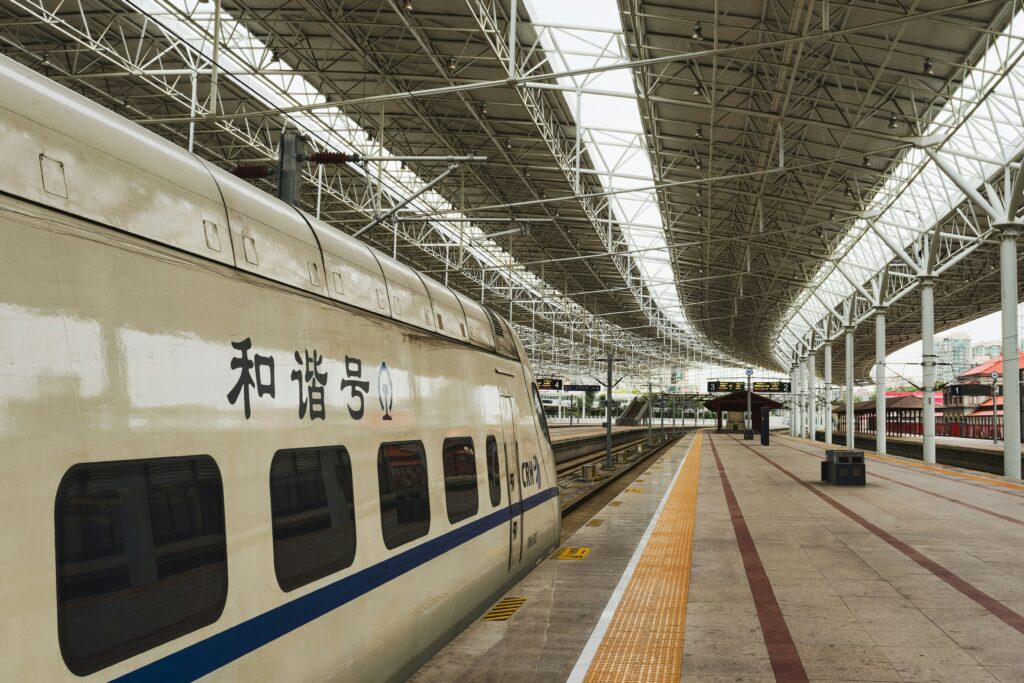
How did we get around? In cities we mainly used the metro and buses for longer distances and walked for shorter ones. To travel from one city to another, we used trains almost exclusively, both local and high-speed services. For longer distances, domestic flights are naturally another option.
The metro is probably the most convenient, fast and inexpensive way to get around major cities. Trains are very frequent and fares vary according to distance: as a rough guide, a typical urban journey costs just a few yuan.
Do not worry too much about the language barrier: in major cities, stations, ticket machines and metro maps generally also provide information in English. Using the apps mentioned above, it is fairly easy to work out which line to take, where to change and which stop to get off at.
How we travelled between cities
During our trip we travelled exclusively by train between cities, using a mix of local trains, high-speed services and one overnight train. We tried to keep costs as low as possible while making the most of the 15 days we had available.
Below are the journeys we made during our trip in March 2024, including stations, times and the prices we paid at the time. Schedules and fares can change, so use them only as a reference and always check current connections before travelling.
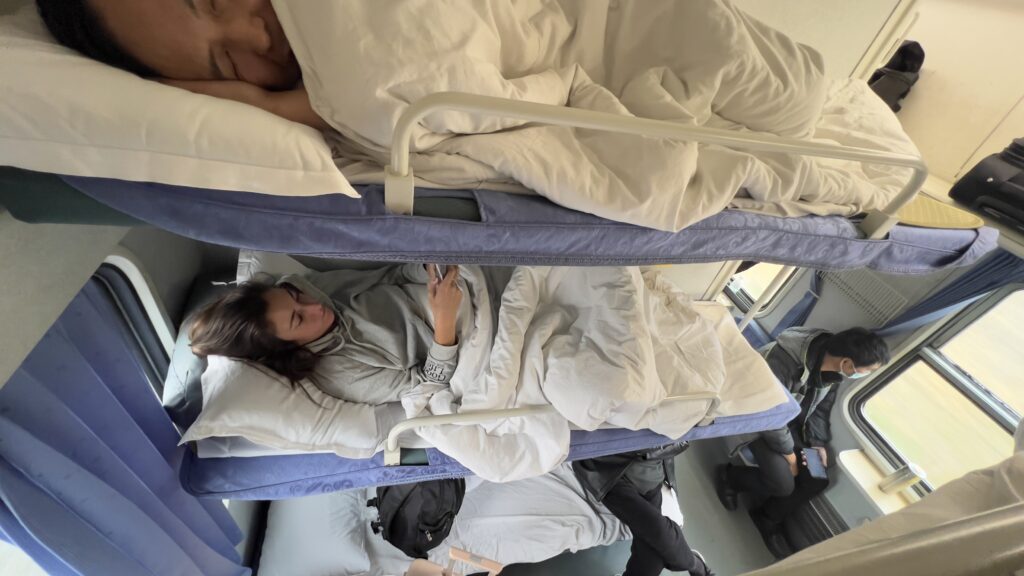
Beijing → Xi’an: to cover the more than 1,000 km between the two cities, we chose an overnight train, saving the cost of a hotel night as well. We left Beijing West at 18:33 and arrived in Xi’an at 07:35 the following morning. We paid €65.89 for two people.
Xi’an → Chengdu: high-speed train from Xi’an North at 09:02, arriving at Chengdu East at 12:23. Cost: €67.18 for two people.
Chengdu → Leshan: train from Chengdu East at 10:00, arriving in Leshan at 10:52. Cost: €13.82 for two people.
Leshan → Guilin: high-speed train from Leshan at 11:15, arriving at Guilin West at 16:31. Cost: €108.88 for two people.
For our final journey, from our accommodation to Guilin Liangjiang International Airport (KWL), we took a taxi arranged directly by the hotel and paid €11.54 in total.
What to see on a trip to China
One important point: always carry your passport with you. In China it is frequently required to enter attractions, museums and tourist sites, especially when bookings are made in your name. In many cases the reservation is linked directly to your passport number, and at the entrance you simply show or scan your passport instead of using a separate ticket.
Of course, what you choose to see depends on how much time you have, your interests and how you decide to divide your days between the different stops.
During our 15 days in China we visited Beijing, Xi’an, Chengdu, Leshan and Guilin. In the guides below you will find everything we learned along the way: how to get there and get around, where to stay, what to see and all the practical information you need to plan your visit.
Cost of travelling in China
During our 15-day trip to China we spent €612.62 per person, an average of around €41 per day. This total included accommodation, meals, attractions and all transport within the country.
In general, travelling in China is not particularly expensive: food, public transport and many attractions are reasonably priced. One of the things that had the biggest impact on our budget was high-speed train travel.
We also recommend booking accommodation a little in advance. We were used to Southeast Asia, where we often booked on the same day, and this caught us out a little in China.
Of course, your budget depends heavily on your travel style. If you travel carefully you can spend even less, while choosing more comfortable accommodation, restaurants and frequent transfers can quickly increase the cost. With a budget of around €80–100 per person per day, you can travel much more freely without having to watch every expense too closely.
Cleanliness and safety in China
Another question we were often asked concerns cleanliness and safety in China. Chinese culture is very different from ours, and some behaviours may initially surprise visitors. Unfortunately, there are still many stereotypes about cleanliness in China, but our experience was very different.
During our trip we found accommodation, restaurants, public transport and toilets generally very clean. You may see behaviours that you are not used to, such as spitting on the ground, but it would be wrong to generalise or use them to judge an entire population.
As for safety, we always felt very comfortable in China, including in large cities and in the evening. Security checks are common: railway stations and many metro systems have security screening and baggage scanners, while several attractions also require your passport.
As we always say, when we visit a country, we are guests: customs and habits can be very different from our own, and it is also our responsibility as travellers to respect them rather than expecting everything to work as it does at home.

15-day China itinerary
There are so many things to do and see in China that a lifetime would not be enough to explore the entire country. With only two weeks available, you inevitably have to make choices.
Below is our 15-day China itinerary, with a few extra stops that you can add depending on the time available and, why not, the weather. Use it as a guideline and adapt it to your interests and travel style.
Beijing
Day 1: arrive in Beijing, check into your hotel and take a first walk around the area. Whatever time you arrive, do not plan too much: the following days will be fairly full.
Day 2: spend the day visiting Tiananmen Square, the Forbidden City and Jingshan Park. The Mao Zedong Mausoleum and the National Museum of China are also nearby.
Day 3: dedicate the day to the Great Wall of China. You can visit independently or join an organised tour, which is what we chose to avoid unnecessary hassle. Once back in Beijing, spend the evening walking through the hutongs.
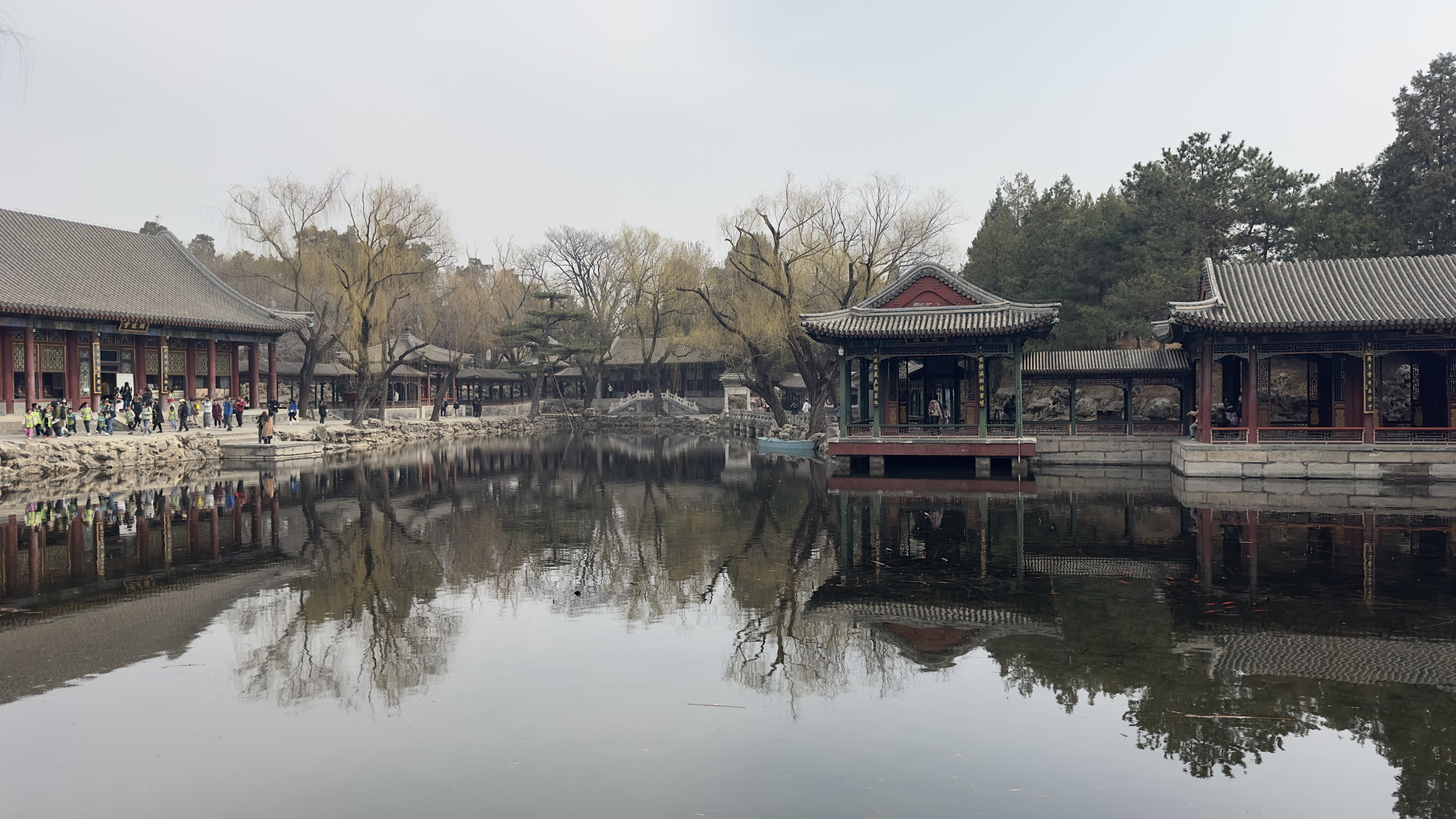
Day 4: visit the Summer Palace, allowing at least half a day for the journey and the visit itself. Once back in the centre, head to the Bell Tower and Drum Tower area, full of hutongs, restaurants and places to stop for a drink.
Day 5: if you choose an overnight train to Xi’an, you will still have most of the day available. You can visit the Temple of Heaven, the Lama Temple or, as we did, explore the CBD and browse the Silk Market and Panjiayuan Antique Market. In the afternoon, collect your bags and head to the station. If you prefer to travel during the day, leave for Xi’an in the morning instead.
Xi’an
Day 6: spend the morning at the Terracotta Army, one of China’s most famous attractions. Once back in the city, wander through the Muslim Quarter, which is also a great place to try local street food. Around sunset, head to the ancient city walls of Xi’an, especially beautiful when the lanterns begin to light up.
Chengdu
We recommend spending a couple of nights in Chengdu. With hindsight, we would skip staying overnight in Leshan, which we did not particularly enjoy.
Day 7: take the train from Xi’an to Chengdu. Once you arrive, spend the rest of the day at People’s Park or the Wuhou Shrine. In the evening, try the famous Sichuan hot pot.
Day 8: in the morning, visit the Chengdu Research Base of Giant Panda Breeding, trying to arrive early when the pandas tend to be more active. Allow at least half a day. In the afternoon, return to the city and walk along Jinli Street.
Guilin
On our trip we spent 5 nights in Guilin, more than we would normally recommend. We had already been travelling for several months, needed to slow down and, above all, torrential rain kept us in our room for much of the stay.
With hindsight, we would organise these days differently. What follows is therefore the itinerary we would recommend today, based on our experience.
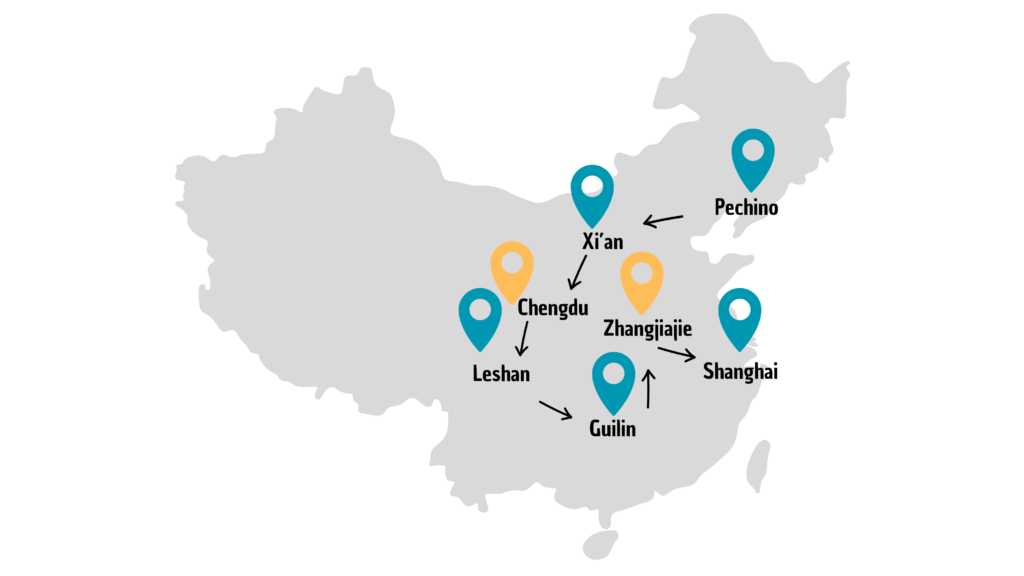
Day 9: leave Chengdu in the morning and take the train to Leshan. Visit the famous Giant Buddha, then continue directly to Guilin in the afternoon. Check connection times on Trip.com in advance, as this route requires a little planning.
Day 10: spend the day exploring Guilin and its main sights.
Day 11: take a Li River cruise to Yangshuo, through one of the region’s most famous landscapes. We returned to Guilin the same day, but with hindsight we recommend spending at least one night in Yangshuo so that you have more time to explore the surrounding area.
Zhangjiajie
Day 12: travel from Guilin to Zhangjiajie. Depending on the connections available, you can consider either the train or a domestic flight. Check both options when planning your itinerary, as journey times and availability can vary.
If you arrive with enough time, you could visit Tianmen Mountain in the afternoon, famous for the spectacular Tianmen Cave and the long cable car that climbs from the city.
Unfortunately, we were not able to visit Zhangjiajie during our trip, so to plan this part of the itinerary we recommend consulting this guide, where you can find more detailed information about visiting Tianmen Mountain.
Day 13: spend the entire day in Zhangjiajie National Forest Park, famous for the towering rock formations that have made this landscape so well known. The park is huge and deserves several days, but with limited time you will need to choose the areas that interest you most. The best known include Yuanjiajie, Tianzi Mountain and Gold Whip Stream.
Day 14: if you have an evening flight to Shanghai, you can spend the first part of the day in the Forest Park or visit another area of Zhangjiajie. In the afternoon, head to the airport and fly to Shanghai, arriving in the evening.
We were unable to include Zhangjiajie in our own trip, so we recommend checking routes, timings and visiting procedures before you leave, using the guide mentioned above.
Shanghai
Day 14: fly from Zhangjiajie to Shanghai. If you choose an evening departure, you can spend a few more hours in the Forest Park; with a morning flight, you will have part of the day to begin exploring Shanghai.
Day 15: if your flight time allows, use your final hours for one last walk around Shanghai before flying home.
Shanghai – alternative to Zhangjiajie
If you prefer to spend the final days of your trip in Shanghai, you can skip Zhangjiajie and fly directly from Guilin. This gives you around three days to explore the city at a more relaxed pace.
Day 12: fly from Guilin to Shanghai, check into your hotel and take a first walk around the area.
Day 13: start at the Bund, the famous waterfront overlooking the Pudong skyline. Continue along Nanjing Road to People’s Square, then in the afternoon head to Yu Garden and the Old City. Around sunset, move on to Lujiazui, home to some of the city’s most iconic skyscrapers, including the Shanghai Tower.
Day 14: spend the day visiting more of Shanghai’s sights. You can see the Jade Buddha Temple and Jing’an Temple, the Shanghai Museum, and finish the day with a walk around Xintiandi.
Day 15: fly home from Shanghai.
Conclusion
If you made it this far, thank you for reading our guide to planning an independent trip to China. We hope you found it useful.
China is a country we really enjoyed and one that, in our opinion, is worth visiting at least once in your life. An ancient culture, enormous cities and landscapes that are completely different from one another made these two weeks genuinely fascinating. The only downside for us? The food. As vegetarians, it was not always easy to find something to eat and, we have to admit, after two weeks we had had enough 😂
If you have any other questions, leave us a comment. Xièxiè! 谢谢